Secure early communication, relationships, movement, curiosity and foundational concepts.
OUR EDUCATIONAL APPROACH
Montessori in practice.
Cambridge in progression.
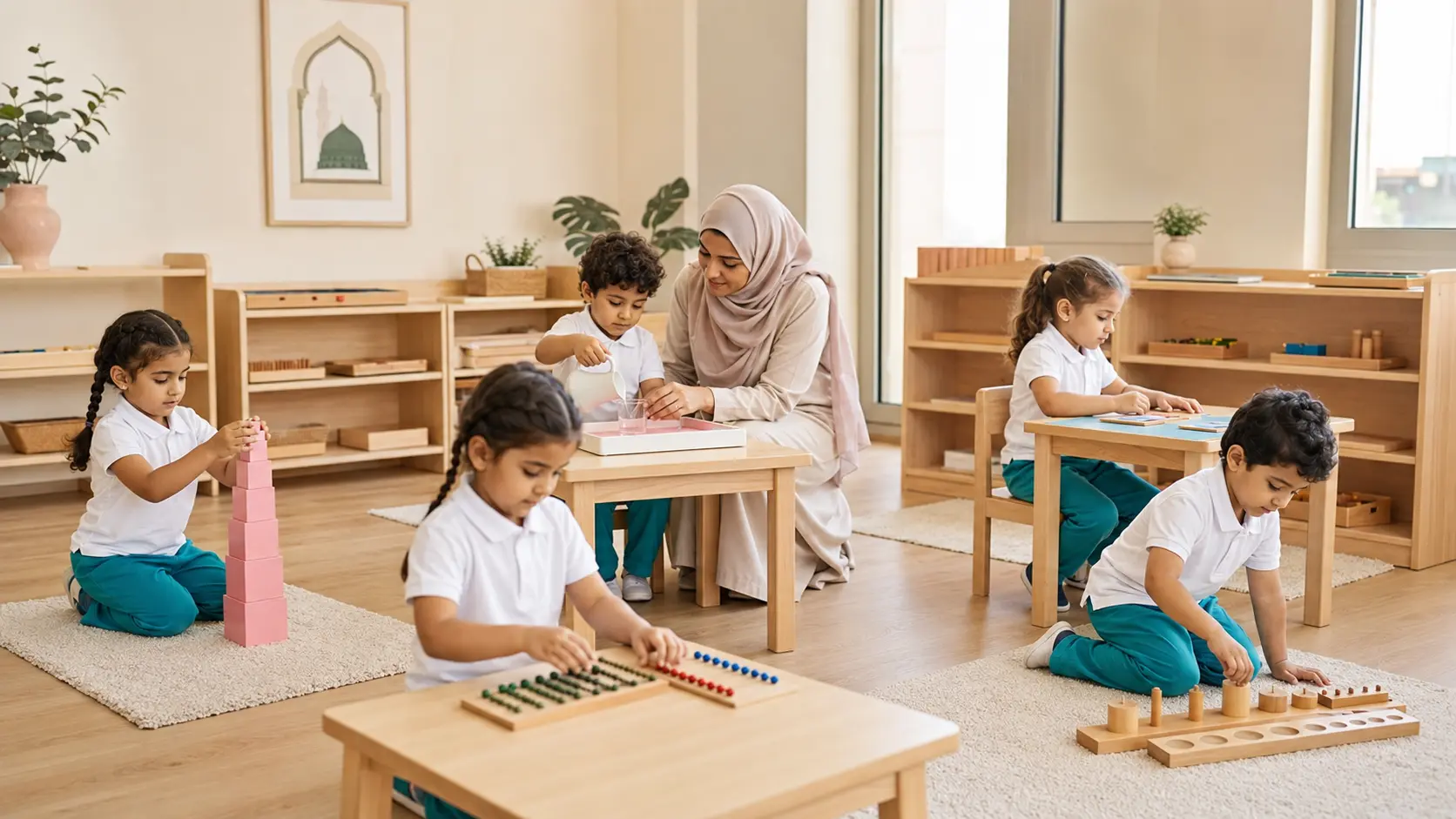
Mini Me combines a prepared Montessori environment with the holistic structure of the British Cambridge Early Years framework in Kindergarten. One shapes how children learn; the other organises what they progressively explore.
HOW THE TWO APPROACHES WORK TOGETHER
Not two competing methods.
One coherent experience.
Montessori provides the daily pedagogy: hands-on materials, independence, carefully presented lessons and sustained concentration. Cambridge Early Years provides a broad developmental pathway across six connected curriculum areas for ages three to six.
THE BRITISH FRAMEWORK · AGES 3–6
Cambridge
Early Years.
A child-centred, play-based programme designed around the whole child. It follows a spiral approach, returning to ideas and skills with increasing depth at each stage.
Extend knowledge, language and confidence through deeper, connected experiences.
Strengthen foundations and support a confident transition into primary education.
Communication, Language & Literacy
Speaking, listening, reading and writing develop through conversation, stories, phonics, meaningful texts and early mark-making.
Mathematics
Children meet number, pattern, shape, measure and mathematical language through play, practical challenges and concrete materials.
Creative Expression
Art, design, music, dance and drama help children communicate ideas, build imagination and connect learning across domains.
Physical Development
Movement through play builds coordination, confidence and positive attitudes towards healthy, active lives.
Personal, Social & Emotional
Children build friendships, self-esteem and self-regulation while learning to understand feelings and respond to others.
Understanding the World
Natural curiosity opens pathways into science, digital literacy, computing, humanities and the wider world.
MEASURING PROGRESS
Observe first.
Plan what comes next.
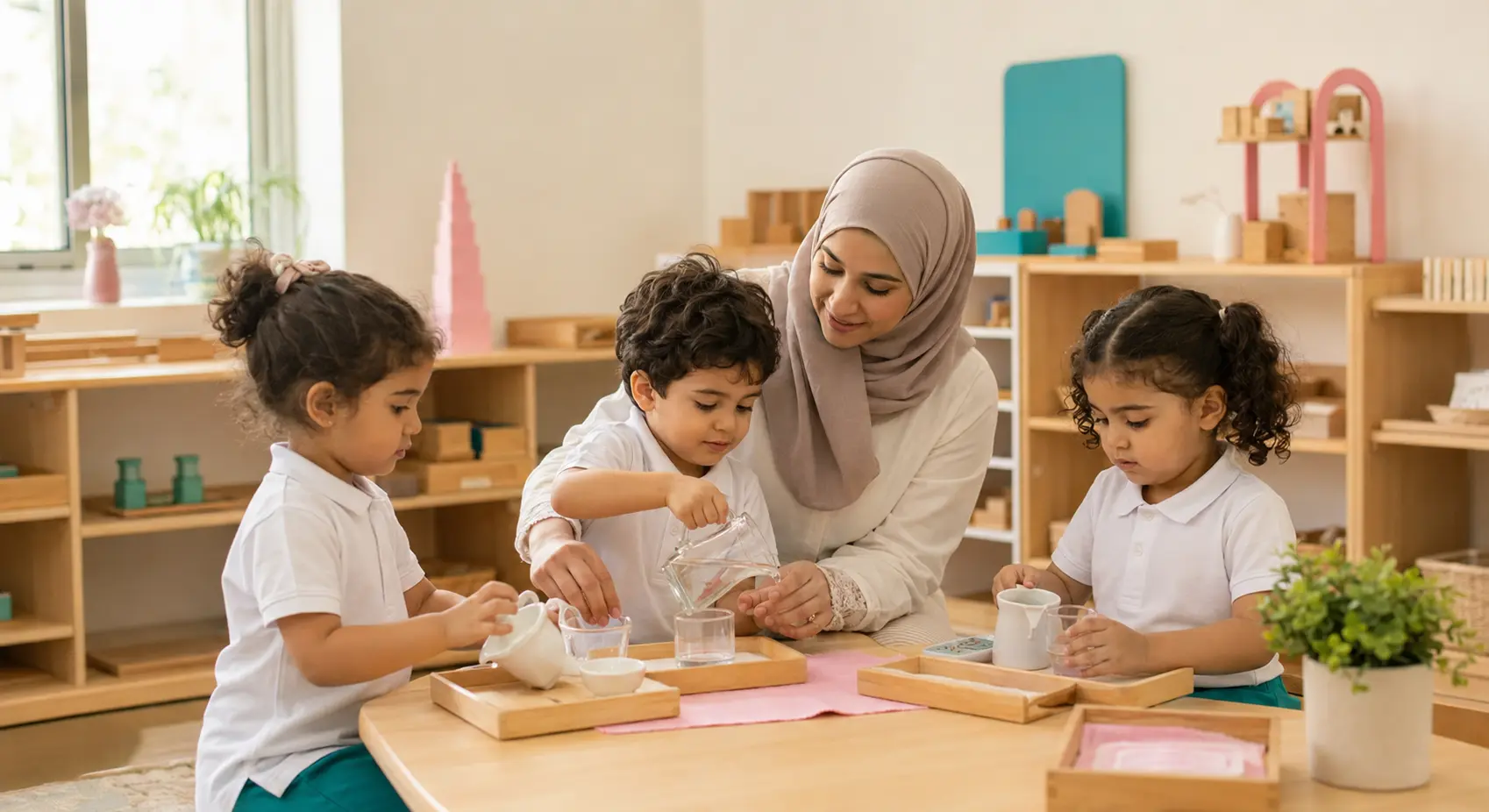
Early-years progress is not reduced to a single test. Teachers use ongoing observation and formative assessment against developmental milestones to understand what a child can do, where support is needed and how to plan the next meaningful experience.
THE FOUNDATION · AGES 2–6
The Montessori
way of learning.
Montessori begins with respect for the child’s natural drive to develop. The environment and adult are carefully prepared so children can act, repeat, concentrate and gradually become capable members of their community.
The Prepared Environment
A calm, ordered and beautiful space with child-sized furniture and purposeful materials arranged for independent access.
Freedom Within Limits
Children choose meaningful work within clear, consistent boundaries that protect the community and support self-discipline.
Concrete Before Abstract
Children touch, move, compare and repeat with carefully designed materials before ideas become symbols and abstractions.
The Uninterrupted Work Cycle
Protected time allows a child to choose, concentrate, repeat, complete and restore work without unnecessary interruption.
The Observing Teacher
The adult prepares, observes and presents precisely, then steps back so the child can practise and discover independently.
Mixed-Age Community
Children learn alongside peers at different stages, creating natural opportunities for modelling, leadership and cooperation.
1870—1952
THE WOMAN BEHIND THE METHOD
Dr Maria
Montessori.
Maria Montessori was born in Chiaravalle, Italy, on 31 August 1870. She broke major barriers for women and became one of Italy’s first female doctors in 1896. Her medical and scientific background shaped an educational approach based on close observation of children rather than adult assumptions.
Her first training course in the approach took place in 1909. Notes from that course became her influential book The Montessori Method, later translated around the world. In 1929, she founded the Association Montessori Internationale to preserve and advance her work. Her legacy is a global approach that sees education as support for the full moral, emotional, physical and intellectual development of the human being.
Learn more from the official Association Montessori Internationale biography ↗
OFFICIAL REFERENCE
Explore the Cambridge
framework.
For the official programme overview, curriculum structure and six learning areas, visit Cambridge International Education.
Cambridge Early Years Curriculum ↗SEE THE APPROACH IN ACTION